
Your companion. Your way of working.
Give it a role, your files, and selected tools. Add skills and memory when the work needs them—not another custom host.
Shape your agentHelp us understand what’s useful. Allow usage analytics with PostHog? No replay or form tracking. Details
Role, files & knowledge
mono-agent.config.json
Organize. Delegate. Inspect.
{
  "runtime": {
    "model": "openai-codex:gpt-5.6-terra",
    "workspace": "."
  },
  "context": {
    "identityPath": "./IDENTITY.md",
    "skillsRoot": "./skills",
    "selectedSkills": ["code-review"]
  },
  "memory": {
    "mode": "lite",
    "writeMode": "append-host-summary"
  },
  "tools": {
    "allowedTools": ["Read", "Grep", "WebSearch"],
    "mcpConfigPath": "./mcp.json"
  },
  "telegram": {
    "enabled": true,
    "allowedChatIds": ["YOUR_CHAT_ID"]
  }
}
Version the blueprint. Identity, skills, MCP definitions, secrets, and live state stay separate.
Start with a model and a point of view. Add only what your work needs.
Set the role, model routes, and reusable instructions that shape each turn.
Give your agent the tools and memory the work needs. Leave the rest out.
Hand focused work to subagents and bounded background jobs.
Schedule recurring work and inspect retained results—not just recollections.
Projects, tags, and persistent subagents are available in v0.22.0 .
Give it a role, your files, and selected tools. Add skills and memory when the work needs them—not another custom host.
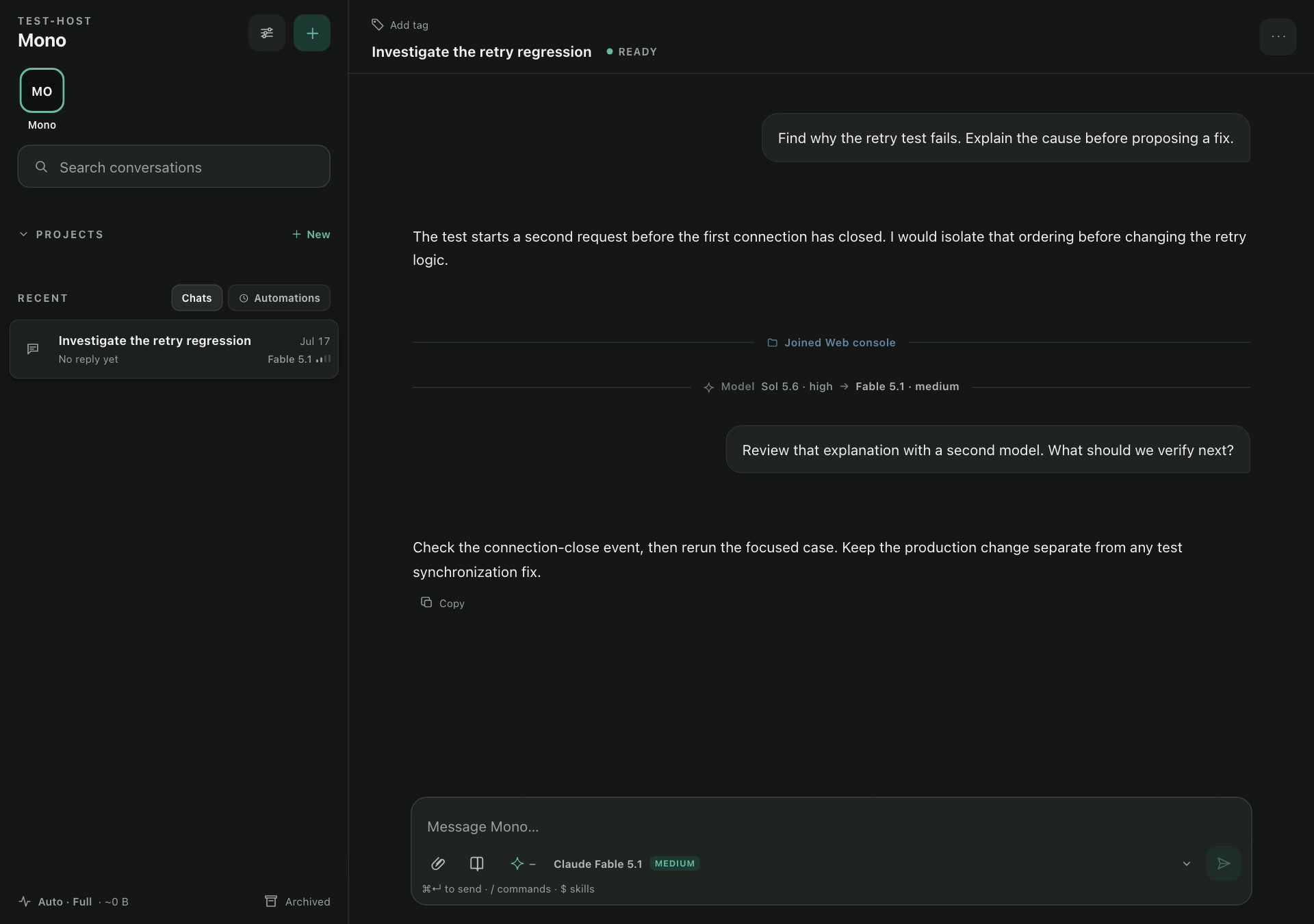
Shape your agentSwitch supported models for the next reply. Delegate a focused task to a persistent subagent, then follow up without rebuilding its brief.
Models & subagentsAfter an interruption, inspect retained tool results—not just remembered facts—before deciding what to do next.
Execution evidenceUse the workspace today. Embed its configured responder in your TypeScript application.
const responder = await
  createConfiguredAgentResponder({ config });
TypeScript excerpt · config loaded from your blueprint. Imports & full example
codex exec.Models, memory, tools, and delegation overlap. These are documented approaches, not a feature or performance ranking. Sources checked 20 September 2026.
A workspace you can extend—not a zero-setup hosted assistant.
Setup is not instant: real model checks take several minutes and count as provider usage.
Requires Node.js 24.15.0 or newer. No pnpm needed.
npm i -g create-mono-agent
Bare init on a terminal is the guided wizard: it
names the agent, writes its role, and proves each model route.
Any flag scaffolds the files only.
mkdir my-agent
cd my-agent
mono-agent initValidate and start the agent, then run the browser console in its own terminal and open the URL it prints.
mono-agent validate
mono-agent start
mono-agent web run --loopbackmono-agent validate to check the shape, finish any
reported setup, and restart after edits.
RunHistory reads settled run evidence; SessionHistory
reads separately retained tool invocations and results, including failures
and interruptions. Curated memory is a different source. Retention is
bounded and records can be incomplete: inspection helps you decide what
to do next, but does not automatically resume work or prove that
repeating a command is safe. Read the evidence boundaries.
<provider>:<model> routes include
subscription and API providers such as OpenAI Codex and
Anthropic, plus fully local providers like Ollama or LM Studio.
Ordered fallbacks can try another route, and results and traces
report when the selected route changes.